Atua ARAtua AR
Augmented Reality: The journeyAugmented Reality: The journey
The idea was to use Augmented Reality (AR) to put a 3D representation of Tāwhirimātea on top of Mount Victoria, Wellington, with behaviours that responded to weather data so users can look up at the mountain to see what the wind is doing.
We started our investigation using AR markers in Unity, a game engine. A marker means the camera recognises an image and anchors your AR object to that image. So we began by putting a barbarian on a box.
We were drawn to AR's ability to reveal unseen aspects, giving the user exposure to magical and spiritual things. As our next step we looked into developing a portal to another world, using the ViroMedia platform.
To make the portal we had to use occlusion, which is the ability for real world objects to hide or be hidden behind our 3D object, as though it is actually there.
These tests put the 3D object in place using a marker or a distance from the user's phone. We needed our Tāwhirimātea to be placed on Mount Victoria using geolocation from the phone's GPS. We also needed buildings to block out his image as the user walked through the busy streets of Wellington, so occlusion was a priority too.
We pulled the Mapbox SDK into Unity, so we could use its mapping software to place Tāwhirimātea in the city centre by GPS coordinates. This also gave us access to maps of the buildings in the city. We applied a material in Unity to give these buildings the ability to block objects out. We painted Tāwhirimātea with an occludable material, like in the portal. This meant that parts of his body would disapper when they were rendered behind a Mapbox building. We turned the Mapbox buildings invisible, so that they would simply disappear. The idea was that these invisible buildings would map to the real world buildings around the user, so Tāwhirimātea would start to disappear when a real world building passed between him and the user.
The mapping of the building is slightly off, but you can see the object's body start to disappear in response to the building.
We used this work to demo the concept of the Augmented Reality app in a tabletop map.
We further refined the occlusion problem by perfecting our geolocation. This tree model demonstrates the enhanced occlusion functionality.
We continue trying to get it perfect so that Tāwhirimātea can be atop Mount Victoria with accuracy. We're committed to making Atua AR as realistic as possible, so it can meet our aims of astounding and inspiring the user.
Who are we?Kō wai mātou?
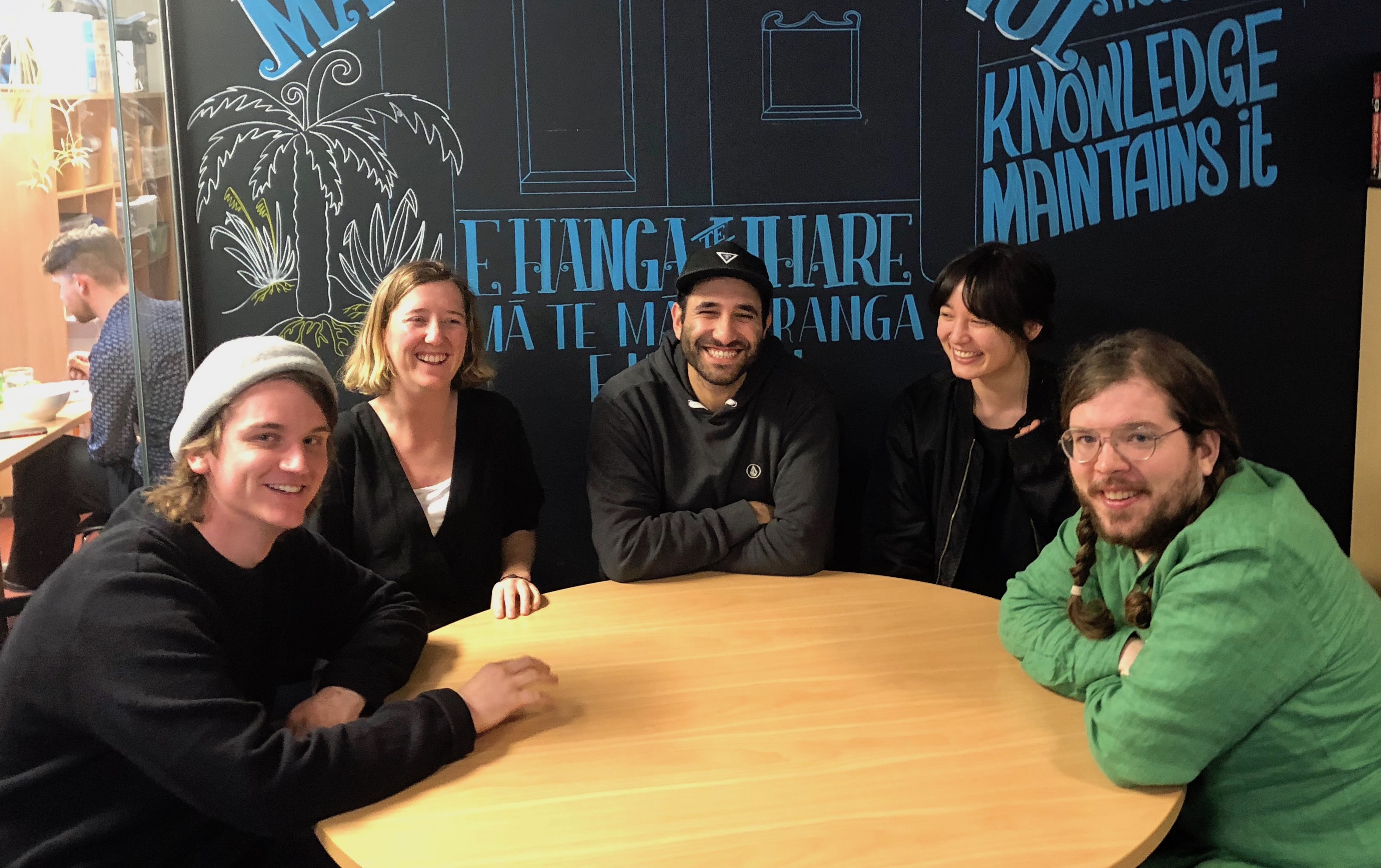
We are Ben Tairea, Laura Suzuki, Anthony Gordon, Zach Mandeville and Maddy King. Ben came up with the vision to use Augmented Reality across Aotearoa to reveal the history and stories of this land.Kō Ben Tairea, Laura Suzuki, Anthony Gordon, Zach Mandeville and Maddy King. I toko ake te whakaaro i roto i a Ben ki te whakaaara i a Augmented Reality kia whai wāhi ai ngā hītori me ngā kōrero o ngā whenua o Aotearoa ki te iwi whānui.
We’re a team of developers who studied at Enspiral Dev Academy, a web development school based in Wellington and Auckland that is committed to a mission of social good. We received help, support and advice from a large range of people, who we thank at the end.He roopu mātau e ako tonu ana i te wānanga o Enspiral Dev Academy, he wānanga whakatipu tukutuku i runga i te ipurangi i roto o Te Whanganui-ā-Tara me Tamaki Makaurau. E tautokohia ana mātau e te tini tangata, e taea te kitea ko wai ngā rōpu tautoko i roto i nga panui e whai ake nei.
Thank You He mihi
ATUA_AR would like to send gratitude towards: Ānei he mihi maioha ki:
- Mitch & Ali from Maggle Creative
- Oscar Keys from the NZVRARA Society
- Steven Knightly from InGame
- Hori Te Ariki Mataki from Ariki Creative
- Vincent Egan from Maui Studios
- Dougal Stott, Ross Jourdain, Harrison Symes, Kelly Keating, Rohan Wakefield, Sarrah Grace and the Kōkako 2018 cohort from Enspiral Dev Academy
- Whitiaua Black
- Alex Mitcalfe Wilson
- Archives New Zealand
- Tangi-te-keo
- Black Dog Brewery
- Legend of Tāwhirimātea (c) Wiremu Grace, sourced from Ministry of Education